SSAT practice that shows you what to work on next.
Walkthroughs, skill reports, and a parent view in one place.
Timed practice for the Middle and Upper Level, a step-by-step walkthrough for every question, and detailed analytics that break down which skills need practice.
A full-length, timed SSAT practice test, plus the full question bank at your child's level.
$49 for 90 days.
Free forever with no credit card. We don't do auto-renewal.
The Problem
Prepping for the SSAT shouldn't be this complicated.
Right now, the SSAT prep market forces you into a corner:
- Pay for weekly sessions but have nothing structured to practice in between?
- Drop a small fortune on a 3-hour virtual bootcamp where your kid is guaranteed to zone out?
- Buy outdated 400-page paper workbooks from Amazon where you flip to the back for a one-line answer key with no explanation?
- Spend $500+ on "premium" online platforms that are really just glorified answer keys behind an auto-renewing subscription?
There has to be a better way.
Built by a PhD scientist and tech leader. But above all, a parent.
When I first navigated the SSAT prep market for my own children, I was struck by how confusing and limited the options were. I quickly realized that the SSAT isn't just a review of what kids are learning in school. It tests concepts years beyond their current grade level. An 8th grader is suddenly staring at high-school geometry, and a 5th grader is asked to reason through multi-step word problems and find the synonym of words like benevolent.
Yet the solutions available were disconnected from our reality. Between regular schoolwork, extracurriculars, and our own full-time jobs, our days were already packed. What I found instead were outdated paper workbooks on Amazon that required flipping to the back for a letter answer with no explanation. Static quiz websites that just spit out "number correct" and left us to figure out what my child actually knew or not. Mysterious tutoring services with zero transparency that required a "consultation" only to charge upwards of $150 an hour.
As a parent, I felt underwhelmed by the options and overwhelmed by how we were going to actually prepare. As a scientist, I knew there had to be a better way.
I built SSAT Coach to be the platform I wished existed for my own family. Your time is limited, and test prep shouldn't take over your life. We designed a system that makes every minute count:
- Every practice section is timed like the actual test, so your child gets used to the actual pacing instead of discovering it on test day.
- Every wrong answer opens a walkthrough, not just a letter answer key. No more flipping to the back of a workbook.
- The AI Coach generates a fresh problem after each miss, so you know your child understood the concept rather than memorizing the answer.
- Analytics tell you exactly what to work on next, so there's no guessing about where your child stands or what to work on.
We didn't just build a modern alternative to traditional test prep. We built a scientifically smarter way to learn.
P.S. SSAT Coach is early and evolving. I read every piece of feedback personally, so if something's broken, unclear, or could be better, please email me at info@ssatcoach.com. I want to hear from you.
Best, Dara Founder, SSAT Coach
Our Approach
How is SSAT Coach different?
SSAT Coach is designed specifically for the SSAT, which differs in nature and style from most tests students are used to. The SSAT has its own question types (synonyms and verbal analogies), no calculator on the math, a 25-minute writing sample that schools read but is not scored, a wrong-answer penalty that rewards knowing when to skip, and short scheduled breaks between sections. Our approach is grounded in rigorous, evidence-based research to give your child's prep time the highest return.
🎯 Practice that targets the right skills.
Behavioral science shows that 15 minutes of focused practice beats a 3-hour weekend cram session (Cepeda et al., 2006). Our analytics track exactly where your child struggles, so they can spend their time mastering weak spots instead of repeating what they already know (Kulik & Fletcher, 2016).
📖 Walkthroughs, not answer keys.
When your kid gets a question wrong, they can tap for a walkthrough that explains why the trap answer was tempting and how to actually solve it. Every question in the bank gets the same treatment (Booth et al., 2013). No more digging to the back of a workbook for a one-line answer key.
⏱️ Pacing that mirrors the actual test.
Pacing trips up a lot of kids on the SSAT. They know the material but run out of time. Our practice sections use the actual SSAT time limits, so your student figures out their pace during practice instead of on test day (Powers & Rock, 1999).
🏁 Endurance for a full-length test.
The SSAT runs about 3 hours for Middle and Upper, counting the writing sample and the short breaks between sections. That's a lot of focus for a student to sustain in one sitting, and full-length timed practice tests are how they build up to it.
🔁 AI-generated "Proof of Mastery."
How do you actually know your kid understood a concept versus just memorizing the answer? When your child misses a question, our AI Coach generates a fresh, structurally similar problem on the spot. If they get the follow-up right, you know it stuck (Adesope et al., 2017).
What you get
See exactly what Full Access unlocks
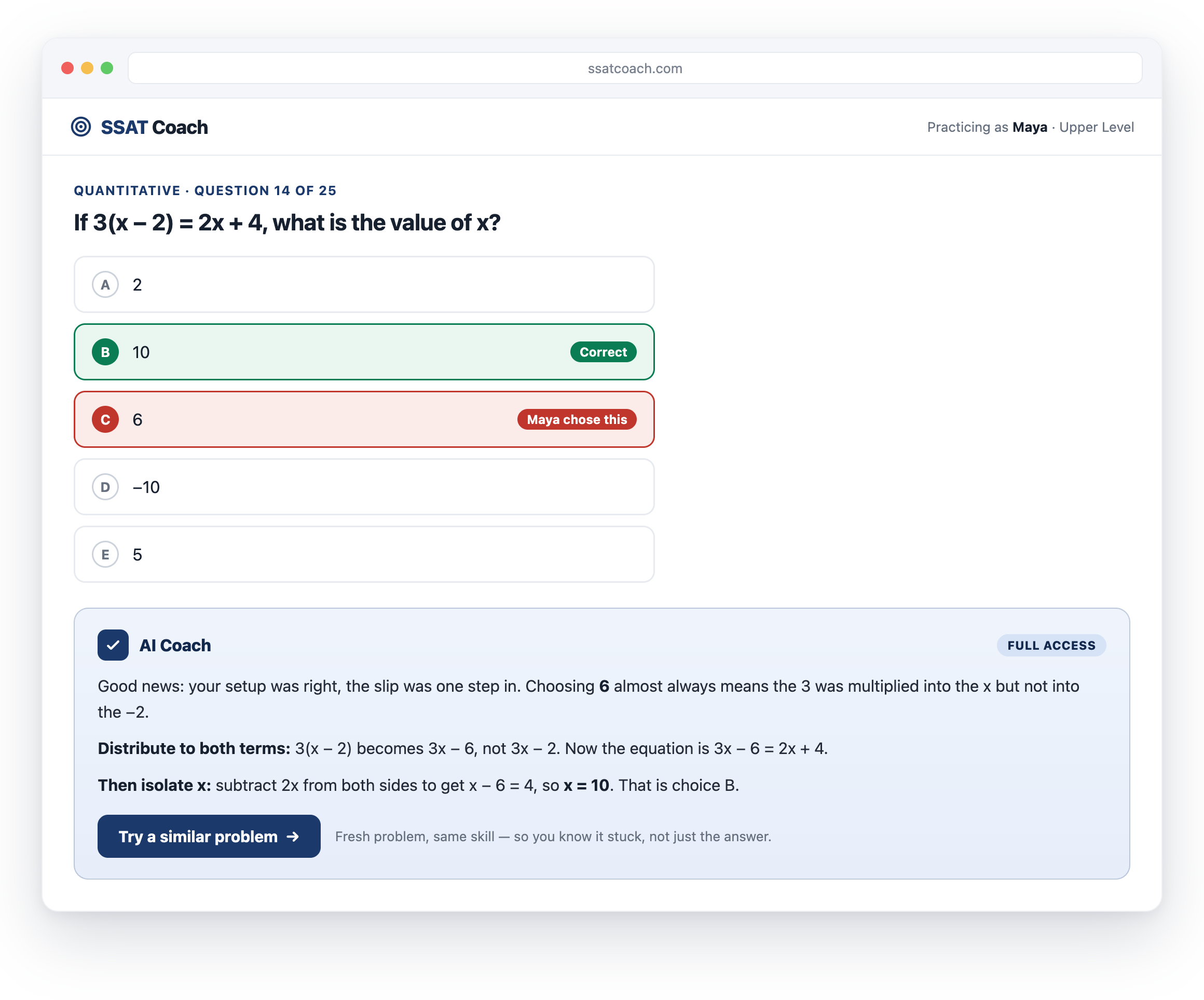
A full walkthrough, not just the answer
Miss a question and the AI Coach shows why the trap answer was tempting and how to actually solve it, then hands your child a fresh problem on the same skill.
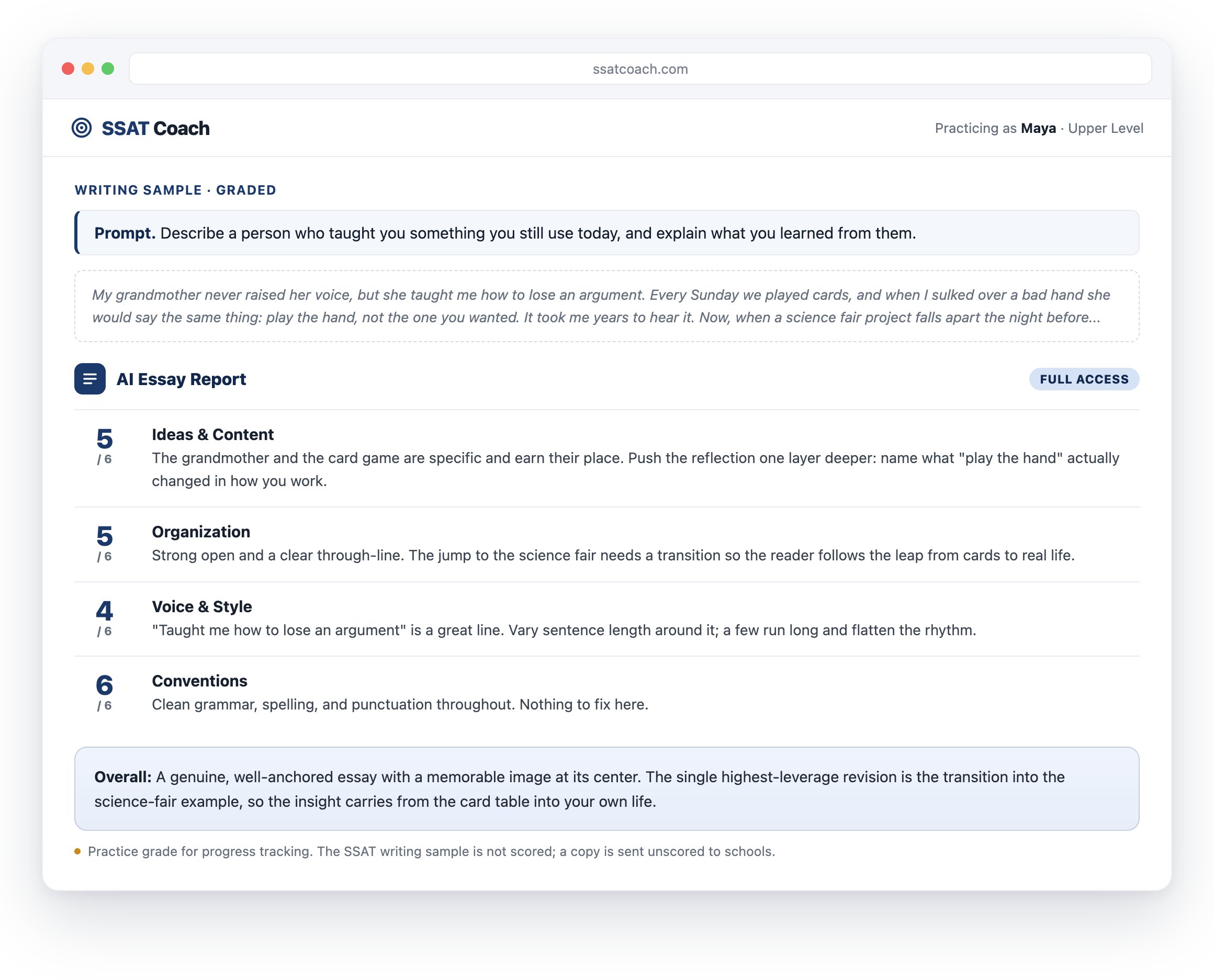
Essay feedback across four dimensions
Every practice writing sample comes back with a rubric grade on Ideas, Organization, Voice, and Conventions, what your child did well, and example sentences that show exactly what to try next.
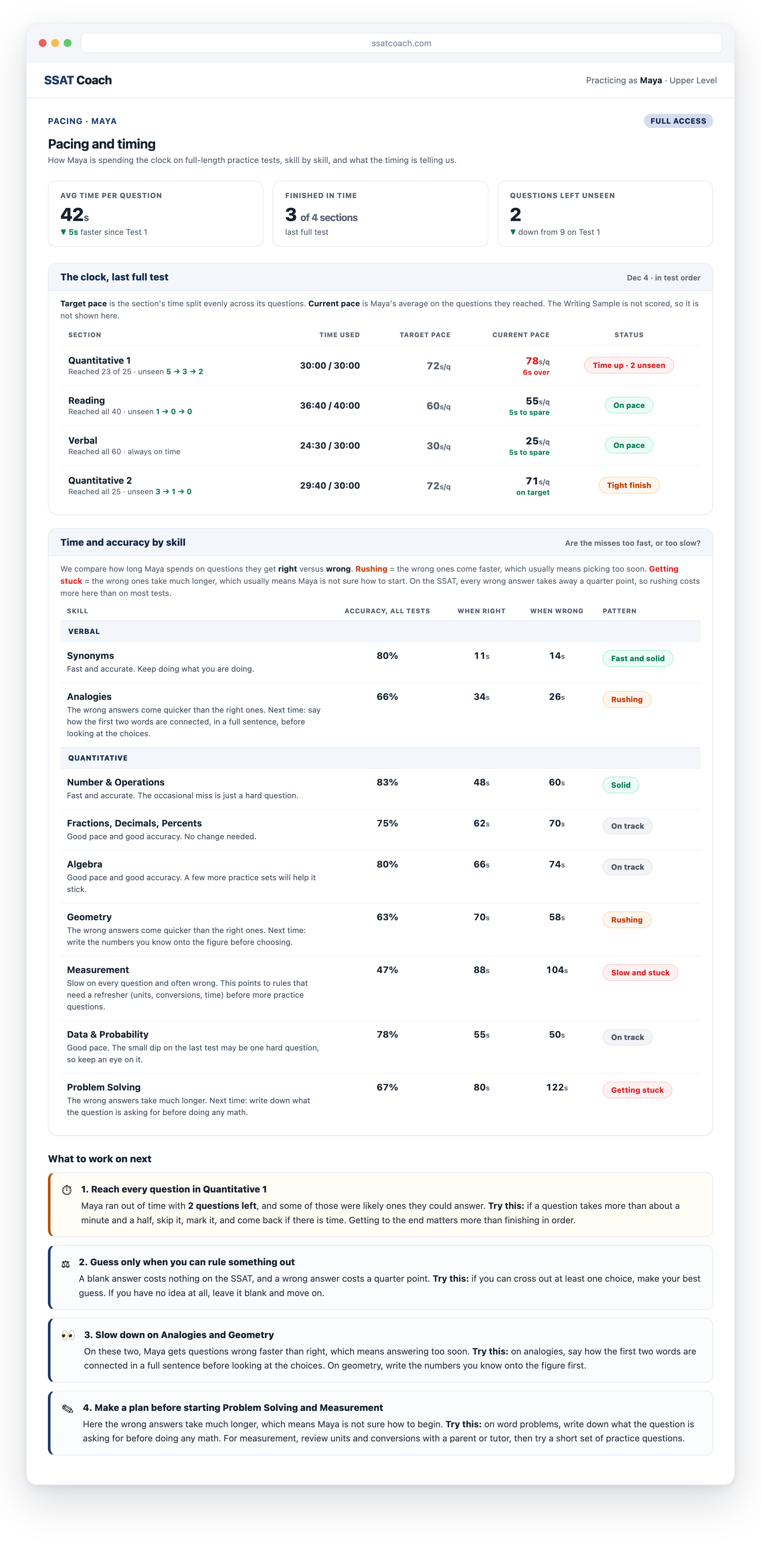
Pacing that shows where the time goes
See how your child's pace compares to the target for each section, which skills they rush and which ones slow them down, and a short list of what to try on the next test.
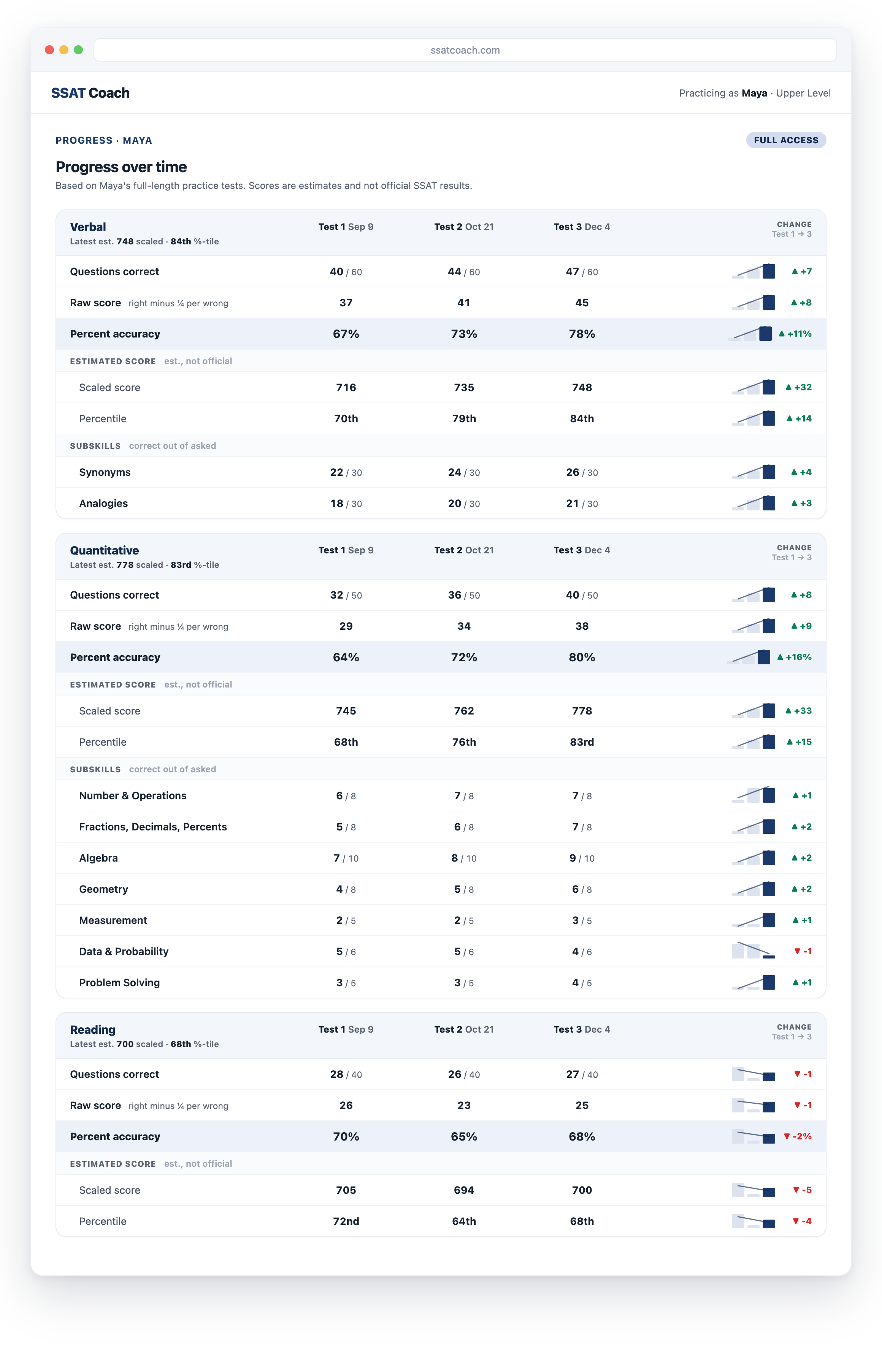
Proof your child is improving
A section-by-section report across every full practice test: questions correct, estimated scaled score and percentile, and each subskill, with the change since the first test.
Sample views shown with example data.
Pricing
Choose the plan that works for you
Full Access is $49 for 90 days. One payment, no auto-renewal.
| Free | Full Access · $49 / 90 days | |
|---|---|---|
| Sign-up cost | Free forever | $49 one-time |
| Practice questions at your level | Full bankEvery question in the SSAT Coach bank at your child's level. | Full bankEvery question in the SSAT Coach bank at your child's level. |
| Timed section practice | All sectionsPractice any section (Verbal, Quantitative, Reading, or the Writing sample) under its SSAT time limit, with unlimited attempts. | All sectionsPractice any section (Verbal, Quantitative, Reading, or the Writing sample) under its SSAT time limit, with unlimited attempts. |
| Static answer explanations | UnlimitedWritten walkthrough for every question showing why the correct answer is correct. | UnlimitedWritten walkthrough for every question showing why the correct answer is correct. |
| AI coach explanations | 5 total (lifetime trial)Personalized AI explanation on what your child got wrong and why. | UnlimitedPersonalized AI explanation on what your child got wrong and why. |
| Similar-problem generator | Not included | UnlimitedAfter each miss, the AI creates a fresh problem on the same skill, so you know the concept stuck, not just the answer. |
| AI essay grading | 1 grade (with diagnostic)A rubric-based AI grade across Ideas, Organization, Voice, and Conventions, included with your diagnostic. | Up to 20 grades / 90-day accessRubric-based AI feedback across the 4 dimensions independent-school readers focus on. Level-adapted (Middle / Upper). Grades are for tracking progress only. On the actual SSAT, the writing sample is sent to schools unscored. |
| Full timed practice tests | 1 diagnostic testA complete SSAT simulation: all question sections plus the writing sample, timed like the actual test. | All full-length testsComplete SSAT simulations, all question sections plus the writing sample, timed like the actual test. |
| Kid profiles | 1 child | Up to 4 childrenSeparate profile per child, so siblings' progress and analytics don't mix. |
| Reports | One test reportScores, skills, and pacing for your practice test. | Progress over timeEvery full test tracked by section, skill, and pacing, with what to work on next. One parent view across all your children. |
| Cross-device sync | IncludedPractice on a laptop, phone, or tablet; progress follows the account. | IncludedPractice on a laptop, phone, or tablet; progress follows the account. |
Have a code from your tutor or school? Sign in, then choose Have a code? at the top of the app.
Buying for 5 or more students? See group pricing for tutors and schools.
Prep by level
Which SSAT level is your child preparing for?
What's on the test
Two Quantitative sections, Reading, Verbal (synonyms and analogies), and a 25-minute writing sample. For students applying to grades 6 to 8.
Read the prep guide →What's on the test
Two Quantitative sections, Reading, Verbal (synonyms and analogies), and a 25-minute writing sample. For students applying to grades 9 to 12.
Read the prep guide →Not sure where to start? Take a free full-length SSAT practice test →
How it works
Create your account
Sign up with your email or Google in 30 seconds. No credit card required.
Add each student
Create a separate profile for each child. Pick their level (Middle or Upper) and filter to the topics they need to work on.
Start practicing
Take a section, a full timed test, or focus on a single topic. Every wrong answer opens an explanation.
Ready when you are
Signing up is free. Buy access from inside the app once you're ready.
Sign in or create an account
Sign in with a one-click email link or with your password.
New here? Start with the email link. Once you're signed in, you can add a password so another parent or caregiver can sign in on their own computer.
By signing in, you agree to our Terms of Service and Privacy Policy. Your kids share this account, so you'll pick their profile after signing in. The email link expires in 1 hour and only works on this device.
Common Questions
Answers to what parents ask most
When is the SSAT offered?
The SSAT is offered several ways. For the 2026-2027 testing year, the Standard paper test dates are October 10, November 14, and December 12, 2026, and January 9, January 30, and March 13, 2027, held on Saturdays at test centers. You can also take the SSAT at Home (online, remote-proctored) on many more dates, take it computer-based at a Prometric test center, or arrange a Flex test on a flexible date through a member school or educational consultant. Most private-school applications close between December and February, so families usually aim for a date about 6-8 weeks before their earliest deadline. Check the SSAT page at admission.org for the current calendar and to register.
How often can my child take the SSAT?
The SSAT can be taken more than once in a single admission year. Between the Standard test dates, the SSAT at Home option, and a Flex test, most families have several chances to sit it, and schools generally consider a student's best scores. The exact limits on how often each test type can be taken are set by E3n, so check the SSAT page at admission.org for the current rules.
Most families schedule a first attempt that lines up with their application deadlines and keep a later date in reserve as a retake option if needed.
Test center, at home, or Flex: how do I choose?
All three use the same test content and scoring. The choice usually comes down to your child's testing style and your logistics.
A Standard test at a test center is best for kids who focus better in a structured, quiet room away from home and household distractions. Set dates, less flexibility, but nothing to set up on your end.
SSAT at Home is best for families who want scheduling flexibility, live far from a test center, or have a child who tests better in familiar surroundings. You'll need a reliable computer with webcam and mic, a quiet room, and a stable internet connection. A live proctor watches the entire test through the webcam.
The test is digital, so SSAT Coach is browser-based and your kid practices in the same on-screen format they'll see on test day.
How much does the SSAT cost, and where do I register?
Registration is through E3n, the nonprofit that provides the SSAT: the SSAT page at admission.org. The base fee depends on the test type and format and changes from year to year, so check the registration site for the current amount. Families who qualify can apply for a fee waiver, and the criteria are on the registration site.
For Standard paper tests there are added surcharges if you register close to the date: a late fee of about $59, then a rush fee of about $100 nearer the deadline. The SSAT at Home option has no late or rush fees. Your registration includes score reports sent to the schools you designate in your account; extra reports cost more.
How is the SSAT different from the ISEE?
Both are admission tests for independent and private schools, and many schools accept either one, so the first question is which test your target schools prefer or require. If they take both, families often pick the test that suits their child. The two exams look similar but differ in a few ways that change how you prepare:
- Who makes it: since March 2026, both tests are run by E3n, the nonprofit formed when EMA (the SSAT's publisher) and ERB (the ISEE's publisher) merged. The tests themselves did not change.
- Verbal question types: the SSAT uses synonyms and analogies. The ISEE uses synonyms and sentence completions. Analogies are an SSAT skill; sentence completions are an ISEE skill.
- Math: the SSAT has two straightforward multiple-choice Quantitative sections. The ISEE splits math into Quantitative Reasoning, which includes quantitative-comparison questions, and Mathematics Achievement. Quantitative comparisons are an ISEE-only format.
- Guessing penalty: this is the big one. The SSAT subtracts a quarter point for a wrong answer and nothing for a blank, so knowing when to skip matters. The ISEE has no guessing penalty, so on the ISEE you answer every question.
- Retakes: the SSAT can be taken several times in a year across its many dates. The ISEE limits students to one sitting per testing season, with three seasons a year.
- Writing: both include an unscored writing sample that is sent to schools.
SSAT Coach is built specifically for the SSAT, including its analogies, its two Quantitative sections, and the guessing strategy the penalty rewards.
What if 90 days isn't enough?
Buy another 90 days. If your access is still active when you buy again, the new 90 days get added on top of your remaining time. You don't lose any days by renewing early.
Is my payment information secure? And what do you do with my data?
Payments run through Stripe, the same processor Shopify and Notion use, so we never see or store your card number. Your child's practice data (name, level, attempts, progress) stays private to your account. We don't sell it, share it with advertisers, or hand it to outside AI companies for training.
My child is at the young end of their level. What if they have not learned the math yet?
This is the most common gap we see, and it is not a practice problem. It is a content problem. A 5th grader sitting the Middle Level, or an 8th grader sitting the Upper Level, is tested on material the older kids in their band have already been taught in school. Giving a child practice questions on a concept they have never been taught just teaches them that math is scary.
So we built the fix, and we made it free: Numbercade. It is an arcade of eight browser games that teach the concepts (lessons first, then challenges) rather than just quizzing them: fractions and fraction operations, ratios and percents, order of operations, solving and setting up equations, slope, geometry, roots and exponents, and probability. Between them they cover many of the core math concepts the SSAT leans on.
No sign-up, no ads, no cost, nothing to install: it runs in a browser and saves progress on the device. If your child hits a wall on a topic here, send them to Numbercade to learn it, then come back and practice it in test format.
What is Numbercade, and is it really free?
Numbercade is our free companion site for building the underlying math skills the SSAT assumes. It is an arcade of browser games that teach a concept first and then challenge it, covering fractions, ratios and percents, order of operations, equations, slope, geometry, roots and exponents, and probability. There is no sign-up, no ads, and no cost, and it saves progress on the device. Use it to learn a shaky topic, then come back to SSAT Coach to practice it in test format. Visit numbercade.com.
Are these actual SSAT questions?
No. Actual SSAT questions are copyrighted and can't be reproduced anywhere. Every question in SSAT Coach is original content, written to closely mirror the SSAT in question type, topic coverage, difficulty, and format. Your kid should walk into the actual test recognizing the structure of every question type they see.
Is SSAT Coach affiliated with E3n or the EMA?
No. SSAT Coach is an independent study tool. The SSAT is provided by E3n, the nonprofit formed in March 2026 when EMA and ERB merged, and SSAT Coach is not affiliated with, endorsed by, or sponsored by E3n.
What's the research backing your approach?
Every claim in the differentiators above is grounded in learning-science research from psychology and education, with a bias toward randomized experiments and large meta-analyses. Here's the primary evidence behind our four biggest claims:
🎯 Targeted practice. Cepeda, Pashler, Vul, Wixted, & Rohrer (2006). Distributed practice in verbal recall tasks: A review and quantitative synthesis. Psychological Bulletin, 132(3), 354-380. Meta-analysis of 317 experiments on the spacing effect. Kulik & Fletcher (2016). Effectiveness of intelligent tutoring systems: A meta-analytic review. Review of Educational Research, 86(1), 42-78. Meta of 50 controlled studies of analytics-driven adaptive tutoring.
📖 Walkthroughs. Booth, Lange, Koedinger, & Newton (2013). Using example problems to improve student learning in algebra: Differentiating between correct and incorrect examples. Learning and Instruction, 25, 24-34. Classroom RCT on worked examples with error explanations.
⏱️ Pacing. Powers & Rock (1999). Effects of coaching on SAT I: Reasoning test scores. Journal of Educational Measurement, 36(2), 93-118. Quasi-experimental study of 4,200 SAT-takers; timed simulation practice was a measurable active ingredient in score gains.
🔁 Proof of Mastery. Adesope, Trevisan, & Sundararajan (2017). Rethinking the use of tests: A meta-analysis of practice testing. Review of Educational Research, 87(3), 659-701. Meta-analysis of 118 randomized experiments; applying a concept to a fresh problem immediately after learning it produces substantially better transfer than restudying.
Why did we intentionally design the "Similar Problem" AI feature?
It's built on the retrieval-with-transfer literature (see the research FAQ above). "Similar" here is what cognitive scientists call an isomorphic problem: it looks different on the surface (different numbers, different scenario) but requires the same underlying logic to solve. When a student gets a question wrong, reads the walkthrough, and is then handed a fresh isomorphic problem, they can't shortcut by remembering the original answer. They have to actually apply the concept to a new scenario. That kind of transfer is what makes learning stick long-term.
Questions or feedback?
Email info@ssatcoach.com with bug reports, feature ideas, or feedback on your kid's experience. I read and respond to every email.