An 8-week SSAT study plan
For Middle and Upper Level students and their parents: a plan that fits around school and activities.
Last updated September 27, 2026.
The short answer
- Start with a full timed practice test to find the skills with the most room to grow.
- Spend most practice time on those skills, in short sessions of about 15 to 20 minutes, four or five days a week.
- Take a full practice test about every three weeks to check progress and update the plan.
- Keep the last week light.
The 8-week plan
| Week | Focus | What to do |
|---|---|---|
| 1 | Find the starting point | Take a full, timed practice test with the writing sample. From the report, pick the two weakest skills and one pacing habit to work on. |
| 2 and 3 | Work on the weakest skills | Four or five short sessions a week on the two focus skills. Add a set of synonyms or analogies twice a week and one timed writing sample. |
| 4 | Check progress | Take a second full practice test. Compare it with the first, and update the focus list. |
| 5 and 6 | Build speed and stamina | Keep the short skill sessions, and add one full timed section each week, like a Reading section or a Quantitative section, to practice pacing. |
| 7 | Final full test | Take a third full practice test. Review every question missed and every question left blank. |
| 8 | Rest and review | One or two short sessions, no new material. Plan the route, the start time, and what to bring. Get a good night's sleep before the test. |
What a practice session looks like
- Pick one skill, like analogies, fractions, or inference questions in Reading.
- Answer a short timed set, about 15 questions in 15 minutes.
- Review every miss right away. Read why the right answer is right and why the wrong answer was tempting.
- Try one more question on the same skill to check that the idea stuck.
Short sessions spread across the week are easier to fit around school and activities, and they give ideas time to settle between sessions.
Vocabulary: a little every day
Synonyms and analogies make up the whole Verbal section, and vocabulary also helps in Reading. Words take time to learn, so vocabulary is the one area to practice nearly every day, even for five minutes. Try this: keep a list of words missed in practice, and review ten of them each day. Breaking a word into parts, like a prefix and a root, helps with words the student has never seen.
Adjusting the plan
- Four weeks: take a full test in week 1 and week 3, focus on the two weakest skills, the guessing rule, and pacing, and keep week 4 light.
- Twelve weeks or more: follow the same pattern, with a full test about every three weeks, and spend the extra time on vocabulary and reading.
- Busy weeks: two 15-minute sessions still count. Consistency matters more than any single long session.
How SSAT Coach helps with this
- The free practice test is a full, timed SSAT diagnostic, and its report shows which subskills have the most room to grow.
- 15-minute practice sets by topic, like synonyms, analogies, or a single area of math, match the short sessions in this plan.
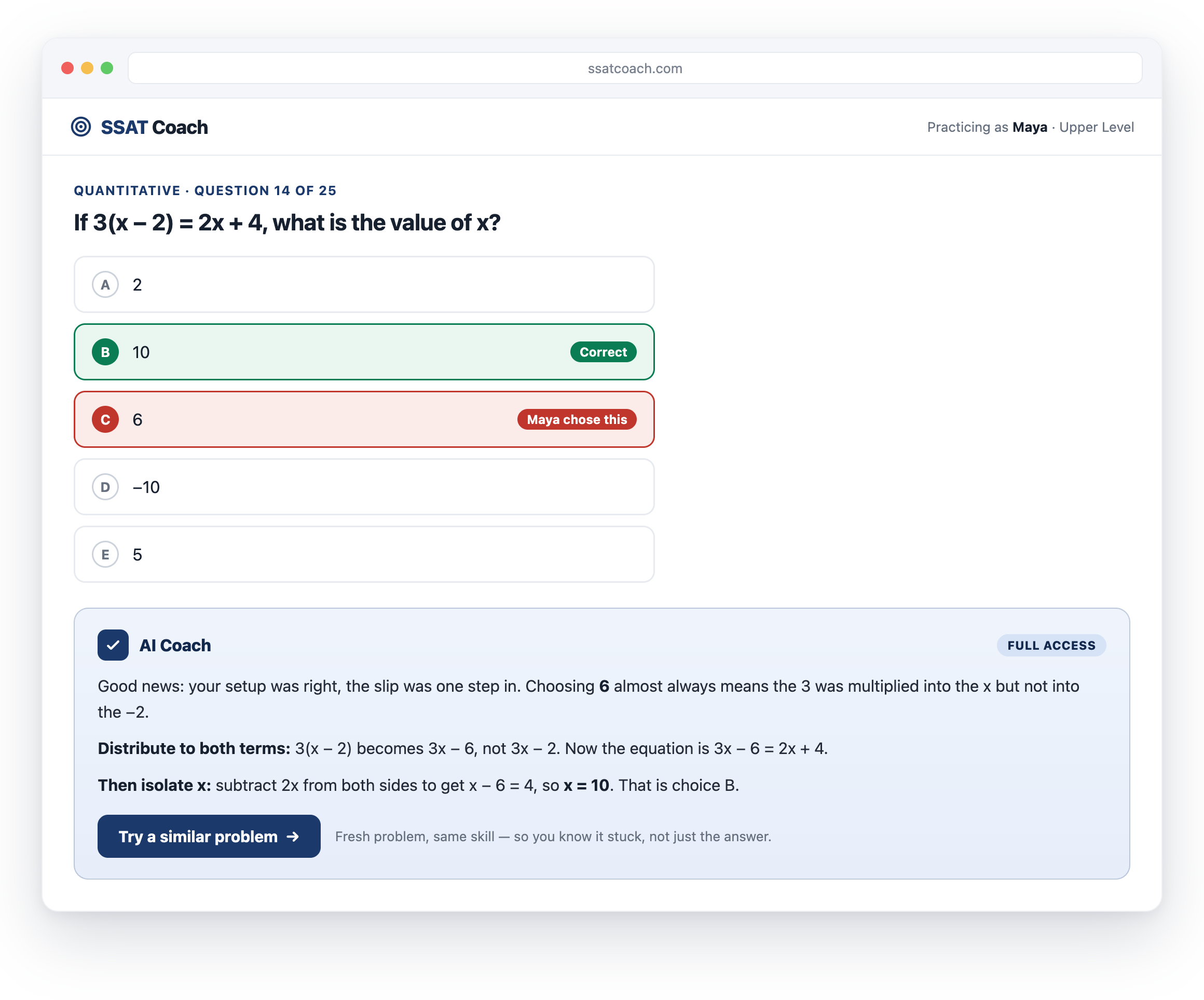
- A walkthrough for every question, plus the AI Coach with Full Access, which explains why the tempting wrong answer was wrong and then offers a similar problem to try.
- Three full practice tests per level with Full Access, which fit weeks 1, 4, and 7 of this plan. The progress report shows the change from test to test.
Full-length and timed, for the Middle or Upper Level. No credit card.
Common questions
How long should you study for the SSAT?
Many families start about 8 to 12 weeks before the test, with short sessions four or five days a week. Four weeks is enough to learn the format, the pacing, and the guessing rule, and to work on the two weakest skills.
How many practice tests should you take before the SSAT?
Three full, timed practice tests spread a few weeks apart work well: one to find the starting point, one to check progress, and one close to test day.
How many hours a week should a student prepare?
For most students, about one and a half to two hours a week of short sessions is plenty, plus a full practice test every few weeks.
What should a student do the week before the SSAT?
Keep practice light, with no new material. Review a few missed questions, plan the logistics of test day, and get plenty of sleep.