SSAT timing: how much time per question, by section
For Middle and Upper Level students and their parents: the clock for each section, and how to use it well.
Last updated September 27, 2026.
The short answer
- Quantitative: 25 questions in 30 minutes, about 72 seconds per question.
- Reading: 40 questions in 40 minutes, about 60 seconds per question, including time to read the passages.
- Verbal: 60 questions in 30 minutes, about 30 seconds per question.
- The whole sitting runs a little over three hours, with two short breaks.
Time per question, section by section
| Section | Questions | Time | Per question |
|---|---|---|---|
| Quantitative 1 | 25 | 30 min | 72 sec |
| Reading | 40 | 40 min | 60 sec, with reading |
| Verbal | 60 | 30 min | 30 sec |
| Quantitative 2 | 25 | 30 min | 72 sec |
The Middle and Upper Levels use the same timing. Upper Level questions are harder, so the same clock feels tighter.
The test day schedule
| Section | Time |
|---|---|
| Writing Sample (not scored, sent to schools) | 25 min |
| Break | 5 min |
| Quantitative 1 | 30 min |
| Reading | 40 min |
| Break | 10 min |
| Verbal | 30 min |
| Quantitative 2 | 30 min |
| Experimental (not scored) | 15 min |
That adds up to about 3 hours and 5 minutes of testing and breaks, before check-in. The experimental section is where the test maker tries out new questions. It does not count toward the score, but students should treat it like any other section. Break lengths can vary a little by test format.
Pacing tips by section
Verbal: synonyms first, then analogies
The 30 synonyms come first and the 30 analogies second. Synonyms usually go faster, since a student either knows the word or can work it out from its parts. Analogies take longer, because the student has to name how the first two words connect before checking the choices. Try this: aim to finish the synonyms in about 12 minutes, which leaves about 18 minutes for the analogies.
Quantitative: skip and come back
72 seconds is an average. Some questions take 20 seconds and others take three minutes. A question that is still unclear after about a minute and a half is using time the easier questions need, and every question is worth the same point. Try this: mark it, skip it, and come back at the end if there is time.
Reading: about five minutes per passage
With 40 minutes and about eight passages, a student has roughly five minutes for each passage and its questions. Try this: read the passage once at a steady pace, then go to the questions and look back for the exact line you need. Rereading the whole passage for each question is the most common way to run out of time.
Check the clock at the halfway point
Halfway through the time, a student should be about halfway through the work: around question 13 in Quantitative at 15 minutes, starting the fifth passage in Reading at 20 minutes, and the start of the analogies in Verbal at about 12 minutes. Try this: if you are behind at the halfway mark, start skipping the slowest questions sooner.
Why students run out of time
- They get stuck on one hard question and do not move on.
- They reread passages instead of looking back for one detail.
- They check every easy question twice.
- They have never practiced a full section on the clock, so the pace is new on test day.
Rushing is the other side of the problem. On the SSAT a wrong answer costs a quarter point, so finishing early with careless mistakes also costs points.
How SSAT Coach helps with this
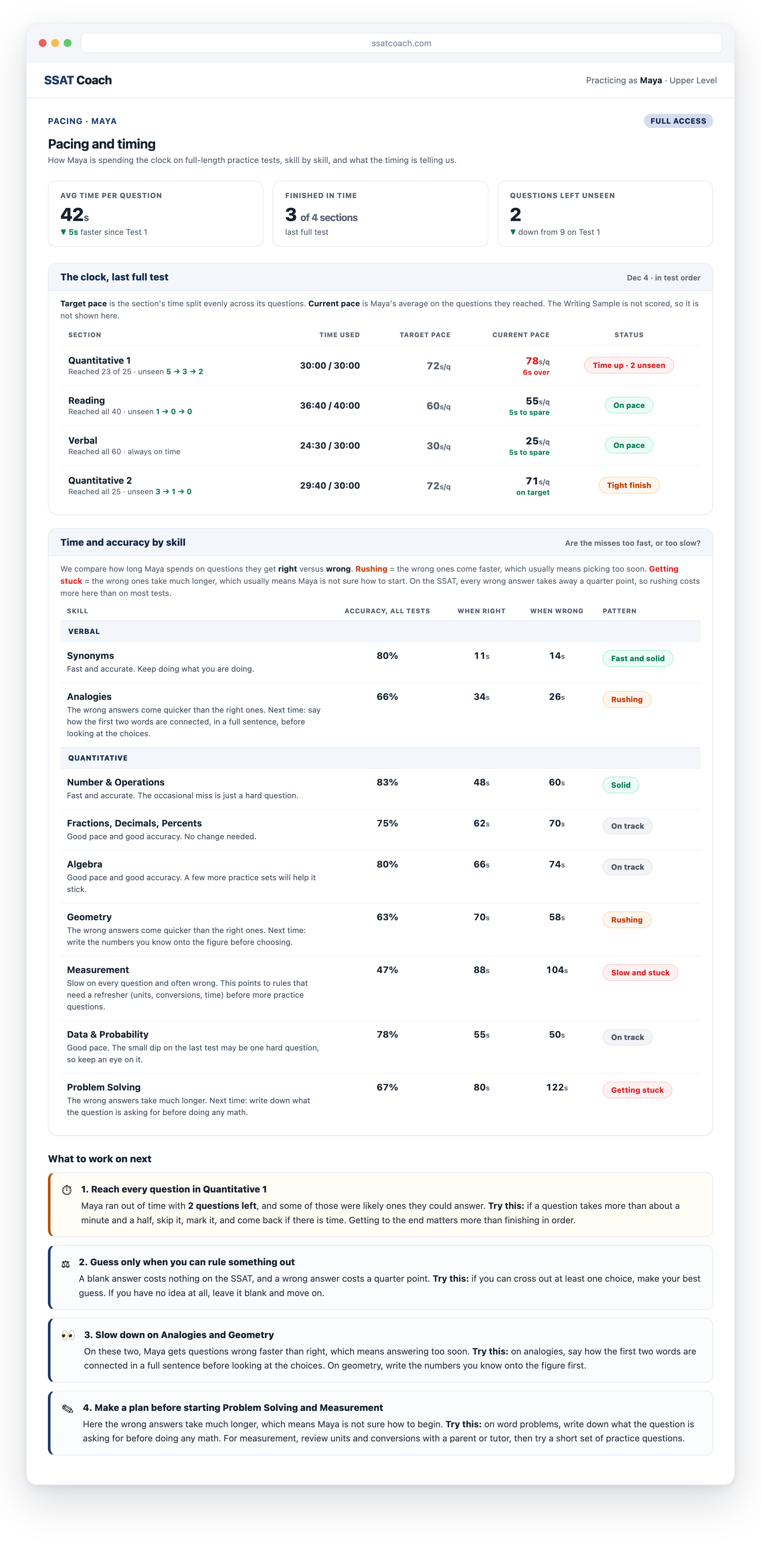
Every practice section in SSAT Coach runs on the SSAT's time limits, and the app records how long a student spends on each question. After each full practice test, the pacing report shows:
- time used and pace against the target for each section, and how many questions were left unreached;
- for each skill, the average time on questions the student got right and on questions they got wrong, which shows whether misses come from rushing or from getting stuck;
- a short list of what to work on next, with one concrete step for each.
Full-length and timed, for the Middle or Upper Level. No credit card.
Common questions
How long is the SSAT?
For the Middle and Upper Levels, the sitting runs a little over three hours. That counts the 25-minute writing sample, the four scored sections, a 15-minute experimental section, and two short breaks.
How much time do you get per question on the SSAT?
About 72 seconds per question in Quantitative, 60 seconds in Reading (including time to read the passages), and 30 seconds in Verbal.
Can you use a calculator on the SSAT?
No. Calculators are not allowed on any SSAT section.
What happens to questions you do not reach?
They count as blanks, which score zero. They do not lose points, but each one is a point the student had no chance to earn.
Can you go back to an earlier section?
No. When a section ends, students move on and cannot return to it, so any time saved in one section cannot be used in another.